| |
|
|
| |
|
|
|
| |
| |
|
|
| |
This article was
written by Naval Historian Air Commodore Derek
Waller, an authority on the fate of German U-boats after the
war. The administrator is very thankful that he agreed to share
his research on this website. |
|
| |
|
|
| |
U-505
in the US Navy - 1944 to 1954 |
|
| |
|
|
| |
(From
Capture - to Disposal - to Display) |
|
| |
|
|
| |
Introduction |
|
| |
In June 1944 the
US Navy captured the Type IXC U-Boat, U-505, in the Atlantic off the west
coast of Africa. It was then taken to Bermuda where, in great secrecy,
it was held for the remainder of the war. After VE Day, a US Navy Press
Release on 16 May 1945 gave the American public their first indication
of the capture and on 20 May U-505 left Bermuda for Philadelphia, where
it arrived on 23 May to take part in the first of two War Bond tours of
the US East Coast and Caribbean ports on behalf of the US Treasury Department.
|
|
| |
 |
|
| |
USS
Pillsbury's boarding party approaches U-505, 4 June 1944 |
|
| |
|
|
| |
By January 1946
it was back at the Boston Naval Base awaiting a decision about its final
disposal as a gunnery or torpedo target. However, thanks to the intervention
of Admiral Daniel Gallery, USN, who had been involved in U-505’s
capture, the U-Boat was eventually saved from its intended fate and, after
protracted negotiations, it was moved to the Chicago Museum of Science
and Industry (MSI) in 1954 where it was renovated, and where it remains
to this day as an historic exhibit. |
|
| |
|
|
| |
The purpose of
this paper is to describe U-505’s time in the US Navy from its capture
in June 1944 and its move to Philadelphia in May 1945 until it was handed-over
to the MSI in May 1954. |
|
| |
|
|
| |
Capture
in 1944 |
|
| |
U-505 was captured
by the US Navy after being forced to the surface 150 miles off the west
coast of Africa, to the west of Cape Blanco, on 4 June 1944 by a US Navy
escort carrier task group. It was then towed, with a US Navy crew, first
by the aircraft carrier USS Guadalcanal (CVE-60), and then by
the tug USS Abnaki (ATF-96) to US Navy Operating Base at Port
Royal Bay in Bermuda for technical examination. Because of the security
imperative to create the illusion that it had been sunk rather than captured,
U-505 was temporarily renamed as USS Nemo, and it was kept in
Bermuda for the remainder of the war. |
|
| |
 |
|
| |
USS
Abnaki (ATF-96) takes the U-505 in tow, 7 June 1944 |
|
| |
|
|
| |
After its arrival
in Bermuda on 19 June 1944, one of the first actions of the US Navy was
to remove its torpedoes (which included two acoustic homing versions)
and to transfer them urgently to the US for inspection and testing. U-505
was then dry docked for a hull inspection and the repair of the damage
that had occurred during its capture. Fortuitously there was no significant
damage to the hull, and thus the US Navy was able return it to the water
with an American crew for trials. Under control of the US Navy’s
Office of Naval Intelligence (ONI), the trials were supervised very closely
by the intelligence and engineering staffs because of the need to learn
as much as possible about the Type IXC U-Boat’s technology and operational
capability. |
|
| |
|
|
| |
U-505
in 1945 |
|
| |
On 16 May 1945,
just a week after VE Day, a US Navy Press Release told the American people
the story of the capture of U-505 for the very first time, and two days
later the US Treasury Department announced that, with the co-operation
of the US Navy, the U-Boat was to be exhibited in six north-eastern seaboard
cities in order to boost the sales of War Bonds. |
|
| |
|
|
| |
The itinerary
for the War Bond Tour had been agreed by Cominch on 17 May, although the
dates were changed on 18 May to allow for the initial movement of U-505
from Bermuda to Philadelphia. Then, on 20 May, ComSubLant advised that: |
|
| |
|
|
| |
| “Upon
arrival U-505 at Philadelphia about 22 May, ComSubRon 7 [will]
assume operational and administrative control of U-505 until further
notice”. |
|
|
| |
|
|
| |
Thus U-505 was
released by the ONI and sailed on 20 May from Bermuda to Philadelphia,
arriving at the latter on 23 May for the start of its exhibition tour.
Indeed, after that, and because of the great success of the first tour
and the interest that U-505’s capture had evoked, the U-Boat later
took part in a second much longer War and Victory Bond tour of the US
East Coast and Caribbean ports in order to raise funds for the war against
Japan - see full details at Annex A. |
|
| |
|
|
| |
For the first
short tour to the north-east coast ports, as well as the transit from
Bermuda, the patrol craft PCE-846 (re-named USS Eunice in February 1956)
was the escort vessel for the initial part (until it arrived in New York),
and the destroyer escort USS Otter (DE-210) then took over as the escort
vessel for the remainder of the tour (from New York until its return to
New London in early July). As to the tour itself, with a US Navy crew,
U-505 visited Philadelphia, New York, Boston, Baltimore, Washington and
Norfolk, spending about 5 days in each. It was open to the public in Philadelphia
from 23 to 27 May, in New York from 28 May until 5 June, in Boston from
7 to 12 June, in Baltimore from 15 to 21 June, in Washington from 23 to
28 June and in Norfolk from 30 June to 5 July, before returning to the
US Navy Submarine Base at New London, Connecticut on 7 July - see Deck
Log extracts at Annex B. |
|
| |
|
|
| |
On
1 August 1945 the destroyer escort USS Neunzer (DE-150) sailed to New
London to escort U-505 on its second (and longer) War Bond tour, this
time both to the East Coast ports and to some of those in the Gulf of
Mexico - see Deck Log extracts at Annex C. The first part of the tour
started in New York for a month (2 August to 3 September), and then
included New Haven (3 to 10 Sep) and New London (10 and 11 Sep) in Connecticut,
Portland (12 to 18 Sep) in Maine, Portsmouth (18 to 24 Sep) in New Hampshire,
and New Bedford (24 Sep to 1 Oct) in Massachusetts. |
|
| |
|
|
| |
U-505 was back
at New London on 1 October, and from there it headed south on the second
part of the tour, which started on 8 October. The U-Boat was on display
at the Centenary Celebrations of the US Naval Academy at Annapolis, Maryland
from 9 to 14 October, and then visited Wilmington (14 to 18 Oct) in Delaware,
Portsmouth (19 to 30 Oct) in Virginia, Charleston (31 Oct to 7 Nov) in
South Carolina, and Savannah (7 to 13 Nov) in Georgia. |
|
| |
|
|
| |
Thereafter, U-505,
together with USS Neunzer, visited five ports in Florida: Jacksonville
(13 to 21 Nov), Miami (22 to 30 Nov), Key West (30 Nov to 5 Dec), Tampa
(6 to 12 Dec) and Pensacola (13 to 18 Dec). It also visited New Orleans
(19 to 27 Dec) in Louisiana and Mobile (28 Dec to 1 Jan 46) in Alabama.
After its visit to Mobile, and after the need for the sale of more War
Bonds had ceased, U-505 was ordered back to New London to await a decision
about its final disposal. During the transit north, it called at the US
Navy Base at Key West (3 to 8 Jan) but, on 9 Jan and whilst U-505 was
still at sea, the Chief of Naval Operations (CNO) sent a message to C-in-C
Atlantic Fleet (CincLant) that he was to: |
|
| |
|
|
| |
| “Sail
U-505 … to Naval Base Boston … for care and preservation.
Place out of service and retain for explosive tests”. |
|
|
| |
|
|
| |
After the Allied
Potsdam Conference ended on 2 August 1945, it was thought that the Tripartite
Naval Commission (TNC) might have jurisdiction over the fate of U-505
and, as a result, the US Navy had some early doubts about the arrangements
for its disposal once the War Bond tours were over. However, the TNC had
accepted that, as the U-Boat had been captured during the war (rather
than surrendering at the end of the war), it was outwith the constraints
of the Potsdam Agreement and did not therefore need to be considered for
early disposal by sinking. |
|
| |
|
|
| |
U-505
in 1946 |
|
| |
After the two
War Bond tours, and its arrival back at the Boston Naval Base on 12 January
1946, the US Navy decided that, as the investigations by intelligence
and engineering officers during U-505’s time in Bermuda had made
them fully familiar with the design of the Type IXC U-boats, and that
as a further Type IXC/40 U-Boat (U-858) was already being refitted prior
to testing, there was no further operational requirement for U-505. |
|
| |
|
|
| |
The detailed US
Navy policy in relation to U-505, as well as to two of the other U-Boats
that had surrendered (U-530 and U-977) and which had also undertaken War
Bond tours in late-1945, was set out in a memo from the US Navy’s
Bureau of Ships (BuShips) to ComSubLant and the Commander of the Portsmouth
Navy Yard (PNY) on 8 January 1946, which stated that: |
|
| |
|
|
| |
| “The
U-505, U-530 and U-977 that were formerly on War Bond Tours have
completed that duty and are now [sic!] berthed at the
Boston Shipyard. |
| |
| No further operations
are expected from these submarines other than as possible targets
for explosives tests. |
| |
| Permission is
granted to take such material and equipment as is needed for spare
parts for the operating U-Boats from these submarines. |
| |
| Removal of material
should not be such that the submarines could not be towed to a
target area and submerged in a static dive”. |
|
|
| |
|
|
| |
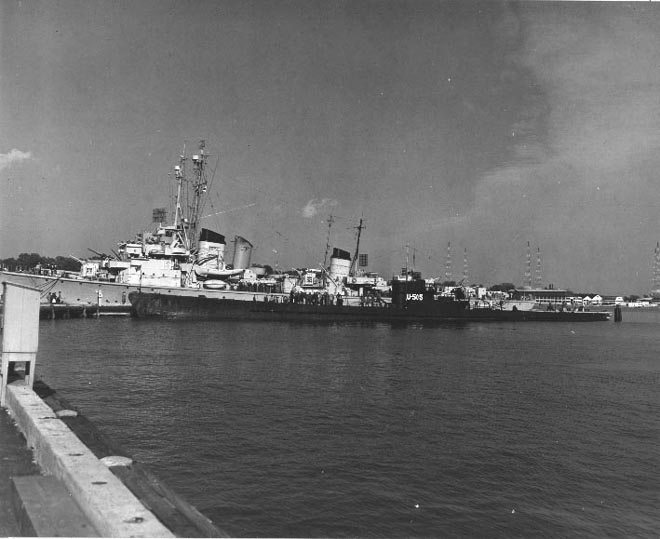
After U-505 arrived
at the Boston Naval Base on 12 January and had formally reported to Commander
Submarine Squadron 1 on 14 January, the latter sent a message to the CNO
on 15 January saying: |
|
| |
|
|
| |
| “U-505
… directed [to] report [to] Commandant Navy Base
Boston for placing out of service at Boston Navy Shipyard. In
view probable future operations required [for U-505] and
prospect additional U-Boats reporting for similar disposition
recommend retention all or part present experienced qualified
U-Boat personnel on board”. |
|
|
| |
|
|
| |
This proposal
was agreed by the CNO on 18 January, and action on U-505 was therefore
put on temporary hold. However, on 10 April 1946 the CNO directed Com
Subron 1 to: |
|
| |
|
|
| |
| “Place
U-505 out of service. As soon as practicable tow U-505 …
to Naval Shipyard Portsmouth NH for removal main storage batteries.
Upon completion removal and when advised by ComNavShipyard Portsmouth,
tow U-505 … to Boston for continued retention for explosive
tests. Personnel allocated U-505 by CNO on 18 January hereby assigned
to U-977”. |
|
|
| |
|
|
| |
Thus, pending
its disposal, U-505 was decommissioned and retained in its role as a source
of spares for the other U-Boats in US Navy service whilst awaiting disposal
as either a gunnery or torpedo target. But, in order to allow it to be
stripped of equipment and spares for spares whilst awaiting a formal disposal
decision, an action that had been completed by the end of September 1946,
U-505 remained at PNY after its transfer there on 3 May 1946. |
|
| |
|
|
| |
U-505
- 1947 to 1954 |
|
| |
The U-Boat’s
proposed fate then came to the attention of Admiral Gallery, who had commanded
USS Guadalcanal when U-505 was captured. The Admiral, who came from Chicago,
and who was by then one of the Assistant Chiefs of Naval Operations, wrote
to Mr Frank Hecht, the President of the Illinois State Council of the
Navy League of the United States on 13 January 1947 asking if the Council
would be interested in sponsoring a proposal to have U-505 transferred
permanently to the City of Chicago. Mr Hecht replied to Admiral Gallery
on 10 February 1947, thanking him for his “most interesting communication”
and saying that: |
|
| |
|
|
| |
| “I
quite agree with you on the desirability of going ahead with your
idea” |
|
|
| |
|
|
| |
and that |
|
| |
|
|
| |
| “I
am passing it on to one of our Directors asking him to explore
the question and present it at the [next] Directors’ Meeting”. |
|
|
| |
|
|
| |
The proposal was
then explored with various organisations in Chicago, specifically the
American Society of Mechanical Engineers and the Museum of Science and
Industry (MSI). The Museum had for a long time had an ambition to display
a submarine, and so the possible acquisition of U-505 was an attractive
idea. It was not, however, until late September 1947 that the project
began to move forward, which was fortuitous, as the US Navy was then making
specific plans to dispose of several surplus U-Boats in torpedo tests
off New England in November 1947. |
|
| |
|
|
| |
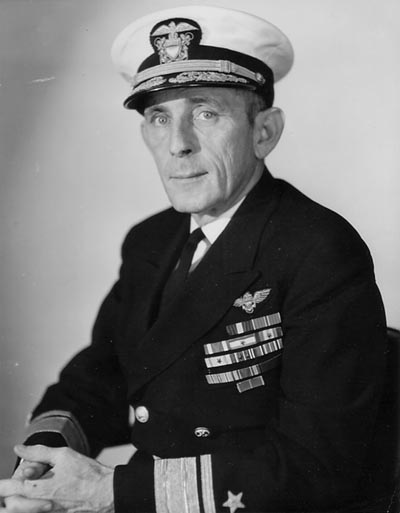
RADM
Daniel Gallery - 28 January 1947 |
|
| |
|
|
| |
Admiral Gallery
knew of the proposed disposal plans, and thus he used his brother, John
Gallery, who was a priest in Chicago, as a go-between to determine if
there had been any progress in relation to his January proposal. By that
time, Major Lenox R Lohr, US Army (Rtd), the MSI Director, had become
involved and had met with Mr E R Henning, who was a New York-based member
of the Mechanical Engineers Society, as well as being a retired US Navy
Captain. John Gallery thus met Major Lohr on 26 September to discuss whether
or not the MSI was interested in the U-505 project. |
|
| |
|
|
| |
The answer was
affirmative, and the next key event was a visit to the US Navy Department
in Washington on the morning of 6 October 1947 by Mr Henning, the purpose
of which was to: |
|
| |
|
|
| |
| “make
inquiries regarding the possibility of bringing the ex-German
U-505 to the lagoon of the Museum”. |
|
|
| |
|
|
| |
The same day,
Mr Henning had lunch with Lenox Lohr, and the former’s follow-up
letter makes the subject of their debate very clear: |
|
| |
|
|
| |
| “From
the policy angle there appears to be no objection. Indeed, it
was indicated by the officers concerned in this field that they
thought the idea had much to commend it, particularly from the
standpoint of naval publicity. The submarine was scheduled for
sinking but recently this was countermanded for further study
of its disposition. Some tentative consideration has been given
to placing it at Annapolis”. |
|
|
| |
|
|
| |
Mr Henning advised
Lenox Lohr that there did not appear to be any insurmountable obstacles
from a technical point of view, though he did say that: |
|
| |
|
|
| |
| “cost
will be a big obstacle”. |
|
|
| |
|
|
| |
He also advised
that: |
|
| |
|
|
| |
| “The
boat has been cannibalised to some degree for parts for other
German submarines”. |
|
|
| |
|
|
| |
and that: |
|
| |
|
|
| |
| “With
this preliminary inquiry indicating no substantial policy or technical
objections, a formal request to the Secretary of the Navy would
appear in order promptly [and] the Navy League in Chicago
might be a help”. |
|
|
| |
|
|
| |
As a result of
this lunchtime meeting, the afternoon of 6 October saw a telegram being
sent jointly by Lenox Lohr and the Chicago Navy League’s President
(Mr Frank Hecht) to the Secretary of the Navy (John L Sullivan) and the
Chief of Naval Operations (Admiral Chester W Nimitz), saying: |
|
| |
|
|
| |
| “We
understand German submarine U-505 captured June 4, 1944 …is
to be destroyed. We feel this craft should be preserved as a monument
to the spirit of the USN and [an] inspiration to youth
of our nation. The Navy League joins with the Museum of Science
and Industry in requesting the USN to install this submarine at
the Museum for pubic display”. |
|
|
| |
|
|
| |
Encouragingly,
Admiral Chester Nimitz responded with a message on 7 October, saying: |
|
| |
|
|
| |
| “Your
message to the Chief of Naval Operations quoting your telegram
to SECNAV regarding preservation of the captured German submarine
U-505 as an historic relic has been received. Your interest in
this matter which is now under study is appreciated and it is
hoped that it may be found practicable to carry out your suggestions”. |
|
|
| |
|
|
| |
Similarly, John
Sullivan, the Secretary of the Navy, wrote to both to both Lenox Lohr
and Frank Hecht on 23 October 1947 saying that U-505 had been removed
from the list of U-Boats to be destroyed in November. However, he also
stressed that any financial implications of the transfer of U-505 to the
MSI would have to be met by organisations and groups in the Chicago area. |
|
| |
|
|
| |
Following this,
Lenox Lohr wrote to Admiral Gallery on 21 November 1947 concerning the
costings and possible funding arrangements, as well as asking if the Admiral
could find anyone who might be interested in sponsoring the project and
backing it financially. He also asked: |
|
| |
|
|
| |
| “to
be assured that the Navy will keep open their offer during the
period necessary to investigate the possibility of securing a
sponsor” |
|
|
| |
|
|
| |
The Admiral’s
reply on 24 November 1947, and written on official CNO-headed paper, stated
that: |
|
| |
|
|
| |
| “A
move is being started here which I believe will result in the
Navy reconditioning and delivering the U-505 to Chicago. It is
too early to say definitely to say that this will be done, but
so far it looks promising. In the meantime, you can be assured
that the Navy will hold the offer of the U-505 open for you”. |
|
|
| |
|
|
| |
Although the US
Navy was now aware of the MSI’s interest in acquiring U-505 as an
exhibit, there were still serious problems concerning the financing of
the project. The MSI and all the interested groups in Chicago were keen
that the US Navy should pay the costs but, despite Admiral Gallery’s
informal optimism, the US Navy was equally determined not to do so. In
essence, therefore, the project became stalled and, in the meantime, U-505
remained in the Navy Yard at Portsmouth, tied up to a jetty; rusting and
neglected. |
|
| |
|
|
| |
Thus began the
second major delay in the U-505/MSI project, a characteristic that was
to be repeated over the next six years. Chicago was unwilling to take
the project forward without a clear view of the funding sources, but was
loath to begin arranging the latter until formal transfer arrangements
had been made by the US Navy. On the other hand, despite Admiral Gallery’s
suggestions to the contrary, the US Navy had no intention of funding the
project, and therefore awaited Chicago’s proposals. Stalemate ensued. |
|
| |
|
|
| |
By the end of
1949 it was clear that the US Navy was losing patience, and U-505 was
once more formally included in a list of ships to be struck from the inventory
and then used either for target practice or sold for scrap. Fortuitously,
John F Floberg, who took up his new appointment as Assistant Secretary
of the Navy (Air) on 5 December 1949, was also the US Navy’s Controller,
and as such he was responsible for signing-off the orders for the scrapping
of obsolete equipment and vessels. He noted that U-505 was due for disposal
and, in view of the U-Boat’s history, decided to advise Admiral
Gallery of its pending demise. |
|
| |
|
|
| |
Thus Admiral Gallery,
who was still a serving officer, but who was nevertheless doing a great
deal of lobbying behind the scenes, for which he was later informally
admonished, once again became aware of the situation and decided to take
action. This time he brought the situation to the attention of Alderman
Clarence Wagner, who was a powerful and influential member of Chicago
City Council. |
|
| |
|
|
| |
As a result, Alderman
Wagner initiated a motion on 20 January 1950 which asked the City Council
to make a formal request to the Secretary of the Navy: |
|
| |
|
|
| |
| “to
present U-505 to the City of Chicago for the purpose of installing
this vessel as a permanent exhibit [at the MSI]”. |
|
|
| |
|
|
| |
However, no formal
action flowed from this initiative, though the Chicago Daily Tribune published
an article about the project on 8 March 1950, concluding that U-505 would
make a worthy trophy for the City. |
|
| |
|
|
| |
In retrospect,
it seems that Alderman Wagner’s action in early 1950 was simply
designed to indicate to the US Navy in general, and to John Floberg in
particular, that there was still local public interest in the project.
Thus, whilst, as a result of John Floberg’s personal involvement
(and no doubt Admiral Gallery’s behind the scenes), the US Navy
kept the disposal of U-505 on hold, there was still no resolution of the
funding problems. Indeed, it was to be another three years (March 1953)
before any further serious action was initiated in Chicago to bring the
project to fruition. |
|
| |
|
|
| |
By early 1953,
U-505 was the sole remaining U-Boat at the Portsmouth Navy Yard, and it
was in a very poor state. There was therefore pressure in the US Navy
to dispose of the vessel, and the public debate was re-opened by a dramatic
headline in the Chicago Daily Tribute which, on 8 March 1953, declared: |
|
| |
|
|
| |
| “City
Told: Act or Lose U-Boat as War Trophy” |
|
|
| |
|
|
| |
This was based
on advice from Admiral Gallery on the previous day that Portsmouth Navy
Yard needed the space that was being occupied by U-505 and that, although
the US Navy had promised to make the U-Boat available to Chicago, its
patience was wearing thin. Unless something positive was done, it was
likely that U-505 would be sold for scrap. |
|
| |
|
|
| |
As a result, a
whole variety of actions were initiated. The City Council debated and
approved Alderman Wagner’s original 1950 resolution on 11 March,
the Mayor of Chicago, Martin Kennelly, became involved and, after a meeting
between him and John Floberg on 1 April 1953, John Floberg wrote to the
Mayor on 7 April 1953 saying: |
|
| |
|
|
| |
| “The
Navy will cooperate in every practical way to help bring the U-505
to Chicago. Please tell your Committee that it can count on my
official and personal cooperation. I earnestly hope that Chicago
will be able under your leadership and that of your Committee
to preserve this combat trophy in the Naval District which furnished
the Navy one third of its personnel in World War Two”. |
|
|
| |
|
|
| |
Though there were
still hopes and aspirations to the contrary, it was at last beginning
to be understood that the US Navy was not prepared to fund the transfer
of U-505 from Portsmouth to Chicago, and that a major fund-raising drive
was necessary. The latter was therefore initiated on 3 April 1953, but
even then there were dissenting voices. |
|
| |
|
|
| |
For instance,
an article in the Chicago American on 22 April 1953 offered the pessimistic
view that: |
|
| |
|
|
| |
| “[U-505],
a museum piece, lies at an East Coast dock but to get it Chicagoans
will have to act fast. It’s nearing the time for it to be
sold for scrap or sunk at sea”. |
| |
| “Had the
city taken action when the boat was first offered to Chicago as
a war memorial in 1948, the cost would have been much less. In
fairly good condition then and with all its original equipment
aboard, the vessel is now a stripped and neglected rusted hulk.
Navy officials fear to move U-505 too far or to experiment with
her diving tanks because of the possibility of it sinking or capsizing.”
|
| |
| “The Navy
Department has thus far refused to allot any money for the upkeep
of the vessel. There are no plans at present to dry-dock her and
Navy men fear such an operation might result in her destruction”. |
|
|
| |
|
|
| |
The question of
funding was also raised in a letter in late April 1953 from the Secretary
of the Navy, Francis Matthews, to the City Council, which provided details
of the estimated costs that would be involved in preparing U-505 for towing
from Portsmouth Navy Yard to Chicago. |
|
| |
|
|
| |
There then followed
a series of high-level exchanges of letters, as well as discussions, between
the US Navy and the City of Chicago, in which the Senator for Illinois,
Everett M Dirksen, as well as two Chiefs of Naval Operations, Admirals
William Fechteler and Robert Carney, as well as Vice Admiral Roscoe Good,
the Deputy Chief of Naval Operations (Logistics), became personally involved
in the proposal to transfer U-505 from the US Navy to the MSI. Perhaps
the most important of these was the letter from the Under Secretary of
the Navy, Charles S Thomas, to Senator Dirksen on 1 June 1953 which -
in relation to the proposed transfer - said that: |
|
| |
|
|
| |
| “Transfers
of this nature [concerning captured vessels] are covered
by Public Law. The law stipulates in part that no expense shall
result to the United States as a consequence of such transfer.
The Mayor of the City of Chicago has been informed that the Department
of the Navy is willing to transfer the U-505 to the City of Chicago
in accordance with the law”. |
|
|
| |
|
|
| |
and that: |
|
| |
|
|
| |
| “The
most difficult obstacle in the way of transferring the U-505 to
the City of Chicago is funding. Funds are not currently available
to the Navy for the specific purpose of repairing the U-505 for
tow”. |
|
|
| |
|
|
| |
This was followed,
on 12 June 1953, by a formal application by the President of the MSI to
Admiral Carney, the Chief of Naval Operations, stating that: |
|
| |
|
|
| |
| “The
Museum of Science and Industry hereby applies for the ex-German
submarine U-505 under the terms of Public Law 649 of the 79th
Congress”. |
|
|
| |
|
|
| |
that: |
|
| |
|
|
| |
| “The
proposed use [is to] establish [U-505] as a permanent
memorial in Chicago to the Americans who lost their lives at sea
in World War II”. |
|
|
| |
|
|
| |
that: |
|
| |
|
|
| |
| “The
Museum agrees that the U-505 will be maintained at no expense
to the United States in accordance with the terms of Public Law”. |
|
|
| |
|
|
| |
and that: |
|
| |
|
|
| |
| “A
committee has been formed … to raise the money to prepare
the U-505 for towing, to tow it to Chicago, and to prepare it
as an exhibit”. |
|
|
| |
|
|
| |
Thus the sparring
was over at last, the US Navy fully intended to transfer title to U-505
to Chicago as long as all preparations had been duly performed, and as
long as Chicago accepted that the funding of the project was its responsibility.
The fund raising and the planning for U-505’s move were now put
on a serious basis, interest in the project rose, money and offers of
help were received from a whole variety of sources and, although there
were still a number of delays for legal, sponsorship and financial reasons,
the Secretary of the Navy, Robert B Anderson, personally signed the transfer
of title of U-505 from the US Navy to the MSI on 9 March 1954. |
|
| |
|
|
| |
U-505’s
last day in US Navy custody was 14 May 1954 when two US Navy tugs towed
the U-Boat down the Piscatauqua River from the Portsmouth Navy Yard to
a buoy in the harbour at Kittery, Maine. The following day U-505 started
its journey to Chicago under tow by the civilian tug Pauline L Moran. |
|
| |
|
|
| |
U-505
post-1954 |
|
| |
Though it had
taken 8 long years of hard, if intermittent, lobbying, planning, work
and fund raising to bring the aspirations to fruition, the movement of
U-505 to Chicago proved to be a monumental and expensive undertaking.
The tug began towing the U-Boat from Kittery on 15 May 1954 on its journey,
which covered 3,000 miles, through 28 locks on the St. Lawrence River,
and through four of the five Great Lakes. |
|
| |
|
|
| |
U-505 arrived
in Chicago on 26 June, and on 25 September 1954 it was dedicated as a
war memorial and a permanent exhibit at the Museum of Science and Industry.
However, when U-505 was donated to the Museum, it had been thoroughly
stripped of parts during the early years that it had lain neglected alongside
the dock in PNY, and still more hard work was necessary to restore and
replace the missing components. |
|
| |
 |
|
| |
U-505
in the Chicago river in June 1954 - Photograph courtesy of Richard Cosby
|
|
| |
|
|
| |
In 1989, U-505,
the only Type IXC U-Boat still in existence, was designated a US National
Historic Landmark. However, by 2004, the U-Boat's exterior had suffered
significant damage from the weather and, in April 2004, the Museum moved
U-505 into a new underground location which was opened to the public on
5 June 2005. |
|
| |
|
|
| |
Conclusion |
|
| |
U-505’s
time in the US Navy was marked by a number of significant phases. First,
its capture in 1944 and subsequent confinement in Bermuda until May 1945.
Second, its two War Bond tours in the latter half of 1945. Third, its
use as a source of spares for other in-use U-Boats in 1946 and 1947. Fourth,
its long period tied-up, rusting and rotting in Portsmouth Navy Yard between
late 1947 and early 1954, during which time it featured on three separate
occasions on the US Navy’s proposed disposal list. And fifth, its
transfer to the Chicago MSI under tow, starting on 15 May 1954. |
|
| |
|
|
| |
Throughout all
that time the US Navy was sympathetic to the idea of the transfer, whilst
steadfastly committed to its position that no Navy funds were available
for application to the project. Finally, it must be acknowledged that
the US Navy’s Admiral Daniel Gallery was the prime-mover in the
whole project. He had captured U-505 in the first place. He came from
Chicago. He suggested the idea that U-505 should be preserved in Chicago,
and he worked tirelessly throughout the whole time from 1947 to 1954,
both openly and behind-the-scenes, to ensure the successful delivery of
the project. Without him it would have never happened. |
|
| |
|
|
| |
Arundel, W Sussex,
England
June 2012 |
|
| |
|
|
| |
Annex
A: U-505 War Bond Tours - Time Lines - May 1945 to January
1946 |
|
| |
|
|
| |
Annex
B: Extract from Deck Logs of USS PCE-846 and USS Otter DE-210 |
|
| |
|
|
| |
Annex
C: Extract from Deck Log of USS Neunzer |
|
| |
|
|
|
| |
|
|
| |
Annex
A |
|
| |
|
|
| |
U-505
War Bond Tours |
|
| |
Time
Lines - May 1945 to January 1946 |
|
| |
|
|
| |
U-505 took part
in 2 separate War Bond Tours. The first between May and July 1945, and
the second (in 2 parts) between August 1945 and January 1946. |
|
| |
|
|
| |
|
|
| |
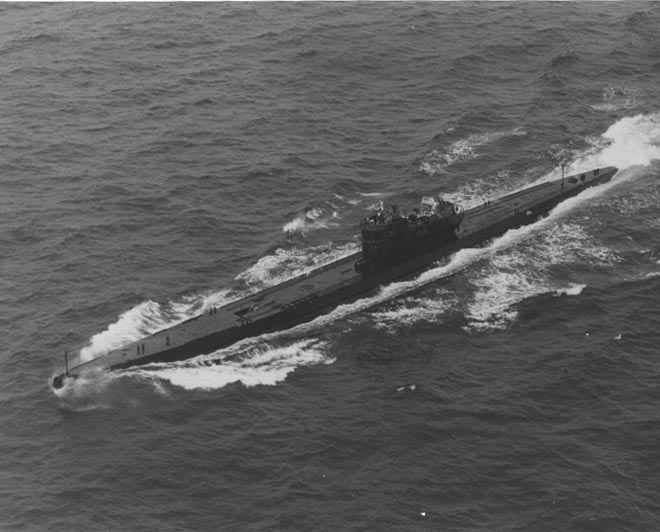
U-505
underway off Delaware about May 1945 |
|
| |
|
|
| |
U-505’s
First War Bond Tour |
|
| |
The patrol craft
USS PCE-846 escorted U-505 on the initial part of its first War Bond tour
(until it arrived in New York), and the destroyer escort USS Otter (DE-210)
was the escort vessel for the remainder of the tour (from New York until
its return to New London). The tour started in Philadelphia and then went
to New York, Boston, Baltimore, Washington and Norfolk. The detailed itinerary
was as follows: |
|
| |
|
|
| |
| A. |
23
- 27 May |
Philadelphia
(Pier 19, Municipal Docks) |
| B. |
28
May - 5 Jun |
New York (Pier A,
The Battery) |
| C. |
7 - 12 Jun |
Boston (Central Wharf,
Atlantic Avenue) |
| D. |
15
- 21 Jun |
Baltimore (Pier 4,
Pratt St) |
| E. |
23
- 28 Jun |
Washington "(Coast
Guard Pier) |
| F. |
30
Jun - 05 Jul |
Norfolk (Merchants
and Miners Pier) |
| G. |
7
Jul |
U-505 then returned
to New London |
|
|
| |
|
|
| |
U-505’s
Second War Bond Tour |
|
| |
On 1 August the
Destroyer Escort USS Neunzer (DE-150) sailed to New London to
escort U-505 on it's second (2-Part) War Bond tour.
|
|
| |
|
|
| |
Part 1 of the
tour started from New London on 2 August, and U-505 made its first stop
at New York, staying there for a month. It then went to New Haven, New
London, Portland, Portsmouth and New Bedford before returning to New London
on 1 October. The detailed itinerary was as follows: |
|
| |
|
|
| |
A. |
2
Aug |
Departed
New London, CT |
B. |
2
Aug - 3 Sep |
New
York (Pier 88) |
C. |
3
- 10 Sep |
New
Haven, CT (Bell Pier) |
D. |
10
- 11 Sep |
New
London, CT (State Pier) |
E. |
12
- 18 Sep |
Portland,
ME, (Grant Trunk Pier, US Naval Station) |
F. |
18
- 24 Sep |
Portsmouth,
NH (Navy Yard) |
G. |
24
Sep - 1 Oct |
New
Bedford, MA (State Pier) |
H. |
1
- 8 Oct |
New
London, CT (Municipal Pier) |
|
|
| |
|
|
| |
|
|
| |
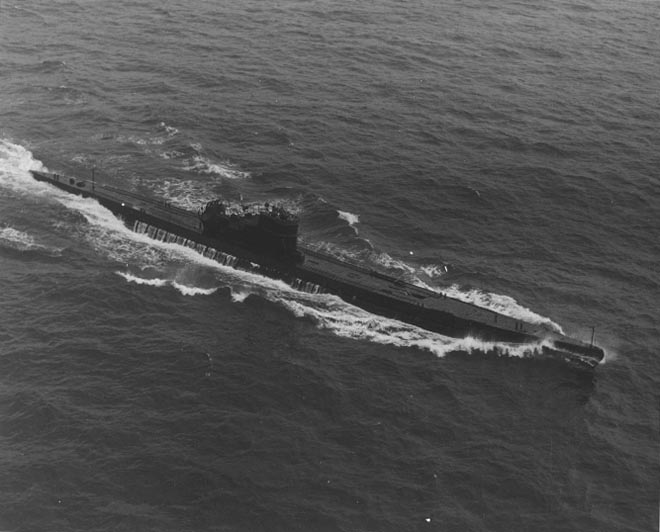
U-505
underway off Delaware about May 1945 |
|
| |
|
|
| |
Part 2 of the
tour started on 8 October 1945 in New London, and U-505 then traveled
down the east coast to Key West, before visiting the Gulf ports of Tampa,
Pensacola,
New Orleans and Mobile. It returned via Key West, and arrived at
the Boston Navy Yard
on 12 January 1946:
|
|
| |
|
|
| |
| A. |
8 Oct |
Departed
New London, CT |
| B. |
9 - 14 Oct |
Annapolis MD, (for
US Naval Academy Centennial Celebrations) |
| C. |
14 - 18 Oct |
Wilmington, DE (Terminal
Dock) |
| D. |
19 - 30 Oct |
Portsmouth, VA (Coast
Guard Dock) |
| E. |
31 Oct - 7 Nov |
Charleston, SC (Clyde
Mallory Lines, Pier 3) |
| F. |
7 - 13 Nov |
Savannah, GA (Gordon’s
Wharf) |
| G. |
13 - 21 Nov |
Jacksonville, FL (Gibbs
Gasoline Repair Dock) |
| H. |
22 - 30 Nov |
Miami, FL (Pier 3,
US Navy Supply Pier) |
| I. |
30 Nov - 5 Dec |
Key West, FL (Clyde
Mallory Dock) |
| J. |
6 - 12 Dec |
Tampa, FL (Clyde Mallory
Dock) |
| K. |
13 - 18 Dec |
Pensacola, FL (Commandanica
Dock) |
| L. |
19 - 27 Dec |
New Orleans, LA (Bienville
Street Wharf) |
| M. |
28 Dec - 1 Jan |
Mobile, AL (L&N
Railroad Dock) |
| N. |
3 - 8 Jan |
Key West, FL (Pier
B) |
| O. |
8 Jan |
Departed Key West
for New London, CT |
| P. |
9 Jan |
Destination changed
(by CNO) to Boston, MA |
| Q. |
12 January |
Arrived Boston Navy
Yard, MA |
|
|
| |
|
|
| |
|
|
| |
U-505
at the US Naval Academy October 1945 |
|
| |
|
|
|
| |
|
|
| |
Annex
B |
|
| |
|
|
| |
Extracts
from Deck Logs of USS PCE-846 and USS Otter DE-210 |
|
| |
|
|
| |
USS
PCE 846 - Patrol Craft Escort |
|
| |
1st
War Bond Tour with U-505 (Part 1) |
|
| |
Extracts
from Deck Log |
|
| |
19
- 29 May 1945 |
|
| |
|
|
| |
| 19 May |
|
| 00.01 |
Moored to Tender Pier,
Naval Operating Base, Bermuda, BWI |
| 16.10 |
Anchored in Port Royal
Bay, Bermuda, BWI |
| 20 May |
|
| 07.03 |
Underway to escort
US Submarine U-505 to Philadelphia |
| 08.35 |
Rendezvoused with
US Submarine U-505. Took departure. U-505 stationed 1500 yards
astern |
| 21 May |
|
| 00.01 |
En-route from Bermuda
to Philadelphia escorting US submarine U-505 |
| 22 May |
|
| 00.01 |
Escorting US Submarine
U-505 from Bermuda to Philadelphia |
| 23 May |
|
| 00.01 |
Escorting US Submarine
U-505 from Bermuda to Philadelphia |
| 00.39 |
Moored portside of
Pier No 3, Philadelphia Navy Yard |
| 11.39 |
Underway to shift
berth to Pier 19 |
| 12.46 |
Moored to Pier 19
North in the Municipal Docks, Philadelphia |
| 24 May |
|
| 00.01 |
Moored to Pier 19
North in Municipal Docks, Philadelphia |
| 25 May |
|
| 00.01 |
Moored to Pier 19
North, Municipal Docks, Philadelphia, aft of U-505 (German submarine) |
| 26 May |
|
| 00.01 |
Moored to Pier 19
North, Municipal Docks, Philadelphia |
| |
|
| 00.01 |
Moored to Pier 19
North, Municipal Docks, Philadelphia |
| 23.45 |
Underway |
| 28 May |
|
| 00.01 |
Underway from Philadelphia,
Penn to New York escorting US Submarine U-505 |
| 16.48 |
En-route to Tompkinsville,
Staten Is., New York |
| 18.17 |
Moored to Pier 8,
Tompkinsville, Staten Is., New York |
| 19.08 |
Underway proceeding
to Pier A, Battery, New York |
| 20.04 |
Moored to Pier A at
the Battery, New York City |
| 28 May |
|
| 00.01 |
Moored to Pier A at
the Battery, New York City |
| 06.30 |
Underway [without
U-505 in company] |
|
|
| |
|
|
| |
USS
Otter (DE-210) - Destroyer Escort |
|
| |
1st
War Bond Tour with U-505 (Part 2) |
|
| |
Extracts
from Deck Log |
|
| |
5
June - 7 July 1945 |
|
| |
|
|
| |
| 5 June |
|
| 00.01 |
Moored to Pier 26,
North River, New York City |
| 07.00 |
Relieved PCE 846 as
escort of U-505 |
| 23.06 |
Underway out of Hudson
River to escort U-505 |
| 6 June |
|
| 00.01 |
En-route from New
York to Boston, Mass in company with U-505 |
| 20.32 |
Moored to Central
Wharf, Boston, MA |
| 13 June |
|
| 05.53 |
Underway from Central
Wharf, Boston, Mass en-route to Baltimore, MD |
| 12.29 |
U-505 on station 1500
yards astern |
| 14 June |
|
| 00.01 |
Underway from Boston,
Mass en-route to Baltimore, MD escorting U-505 |
| 19.57 |
Moored to Pier 4,
Baltimore, MD |
| 22 June |
|
| 05.05 |
Underway from Pier
4, Baltimore Md. En-route to Washington, DC in company with U-505 |
| 18.35 |
Moored to US Coast
Guard Pier, Washington, DC. U-505 in vicinity |
| 29 June |
|
| 15.16 |
Underway from Coast
Guard Pier, Washington, DC to escort U-505 |
| 19.18 |
Moored to Merchants
and Miner’s Transportation Co Pier, Norfolk, VA |
| 5 July |
|
| 17.47 |
Underway from Merchants
and Miner’s Transportation Co Pier, Norfolk, VA to New London,
Ct in company with U-505 |
| 7 July |
|
| 00.01 |
Underway from Norfolk,
Va to New London, CT in company with U-505 |
| 05.44 |
Entering Block Island
Sound Channel |
| 07.28 |
All engines stopped.
Escort duty completed with U-505 |
|
|
| |
|
|
|
| |
|
|
| |
Annex
C |
|
| |
|
|
| |
USS
Neunzer (DE-150) - Destroyer Escort |
|
| |
2nd
War Bond Tour with U-505 |
|
| |
Extracts
from Deck Log |
|
| |
1
August 1945 to 12 January 1946 |
|
| |
|
|
| |
| 1 Aug |
New London,
CT |
| 2 Aug |
Departed New London
[with U-505 in company] |
| 2 Aug |
Moored, Pier 92, North
River, New York |
| 3 Sep |
Departed New York,
passage to New Haven, CT |
| 3 Sep |
Moored, Bell Pier,
New Haven, CT |
| 10 Sep |
Departed New Haven,
passage to New London, CT |
| 10 Sep |
Moored, State Pier,
New London, CT |
| 11 Sep |
Departed New London,
passage to Portland, ME |
| 12 Sep |
Moored, Grant Trunk
Pier, Naval Station, Portland, ME |
| 18 Sep |
Departed Portland,
passage to Portsmouth, NH |
| 18 Sep |
Moored, Pier 5, Berth
4, Navy Yard, Portsmouth, NH |
| 24 Sep |
Departed Portsmouth,
passage to New Bedford, MA |
| 24 Sep |
Moored, State Pier,
New Bedford, MA |
| 1 Oct |
Departed New Bedford,
passage to New London, CT |
| 1 Oct |
Moored, State Pier,
New London, CT |
| 8 Oct |
Departed New London,
passage to Annapolis, MD |
| 9 Oct |
Moored, Santee Pier,
US Naval Academy, Annapolis, MD |
| 14 Oct |
Departed Annapolis,
passage to Wilmington, DE |
| 14 Oct |
Moored, Maine Terminal
Dock, Wilmington, DE |
| 18 Oct |
Depart Wilmington,
passage to Portsmouth, VA |
| 19 Oct |
Moored, Coast Guard
Dock, Portsmouth, VA |
| 30 Oct |
Depart Portsmouth,
passage to Charleston, SC |
| 31 Oct |
Moored, Clyde Mallory
Lines Pier 3, Charleston, SC |
| 7 Nov |
Departed Charleston,
passage to Savannah, GA |
| 7 Nov |
Moored, Atlantic Coast
Line Dock, Savannah, GA |
| 13 Nov |
Departed Savannah,
passage to Jacksonville, FL |
| 13 Nov |
Moored, Gibbs Gasoline
Repair Dock, Jacksonville, FL |
| 21 Nov |
Departed Jacksonville,
passage to Miami, FL |
| 22 Nov |
Moored, Pier 3, US
Navy Supply Pier, Miami, FL |
| 30 Nov |
Departed Miami, passage
to Key West, FL |
| 30 Nov |
Moored, Clyde Mallory
Dock, Key West, FL |
| 5 Dec |
Departed Key West,
passage to Tampa, FL |
| 6 Dec |
Moored, Clyde Mallory
Dock, Tampa, FL |
| 12 Dec |
Departed Tampa, passage
to Pensacola, FL |
| 13 Dec |
Moored, Commandancia
Dock, Pensacola, FL |
| 18 Dec |
Departed Pensacola,
passage to New Orleans, LA |
| 19 Dec |
Moored, Bienville
Street Wharf, New Orleans, LA |
| 27 Dec |
Departed New Orleans,
passage to Mobile, AL |
| 28 Dec |
Moored, L&N Railroad
Dock, Mobile, AL |
| 1 Jan 46 |
Departed Mobile, passage
to Key West, FL |
| 3 Jan |
Moored, Pier B, Key
West, FL |
| 8 Jan |
Departed Key West,
passage to New London, CT |
| 9 Jan |
Destination changed
to Boston, MA |
| 12 Jan |
Moored, Pier 6, Charlestown
Navy Yard, Boston, MA |
|
|
| |
|
|
| |
|
| |